

“I’m Sorry Dave, I’m Afraid I Can’t do That”
A Warning About ‘AI’
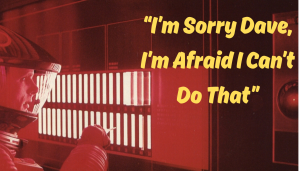
Back in 1968, Sir Arthur C. Clarke wrote a story called 2001.
Clarke was a brilliant and classic sci-fi writer, and the story was a suggestion about how the world might be forty or fifty or so years hence.
I think his timing might have been just a little out.
The story, along with subsequent novels, told of the normal travel and exploration of the solar system, not as it really is now 60 or so years later, but like travelling in a normal aircraft to space stations and other planets.
This was facilitated by supercomputers, one of which, piloting the mission to Jupiter, was a play on the predominant computer company of the time, IBM, using the letters preceding IBM, which are HAL the main flight computer controlling the mission.
Although Clark didn’t use the term, HAL was an advanced example of what we now call AI, or artificial intelligence and Clark, apart from perhaps HG Wells, was one of the few to highlight the potential drawbacks and/or possibilities of AI.
In the movie made in 1968, HAL makes the decision it doesn’t need the humans accompanying it on the voyage.
We see a “Computer Malfunction” message and then “Life Support Terminated” for the three crew members travelling in suspended animation, another prediction which hasn’t come about quite yet.
HAL also locks out and cuts off the co-pilot while carrying out an EVA to fix something outside leaving just the pilot, Dave Bowman, alive on the ship.
Bowman realising what’s going on and what’s happening after HAL refuses a simple request, eventually successfully manages to disable HAL’s AI functions.
This tale demonstrates while AI has its uses, it should never be allowed to assume control and use its own ‘machine logic’ to override human decision making.
The situation we have today, which Clarke described as being achieved around 25 or more years ago, is we’re creating AI systems ‘everywhere’ and in many situations making the entirely false assumption, in my opinion, that AI can do stuff, which in some cases it can, and make decisions on our behalf, which it definitely can’t!
Companies of the calibre of Ford are now rehiring people who they dispensed with on the advent of AI, because the truth is that artificial intelligence just ‘isn’t’.
It has no element of intelligence whatsoever.
What it’s good at, and much quicker than people, is the assembly, collation and summary of the information or data it has been provided with or given access to.
It has no powers of reason or assessment to any extent and rather than “taking, taking all our jobs” it has resulted in a growing increase in employment throughout the world just like ‘back in the day’ when computers and IT were introduced and even when mechanical typewriters were invented.
The message is the power of the human brain is far, far greater than any machine we can create to mimic it. We can use these developments as tools to make our lives easier but we must not attempt to design or even allow them to ‘take control’ as Clarke demonstrated in his 1968 ‘Space Odyssey’.